

Why Do Businesses Need Custom SEO Services for AI Search?
Sep 30, 2026


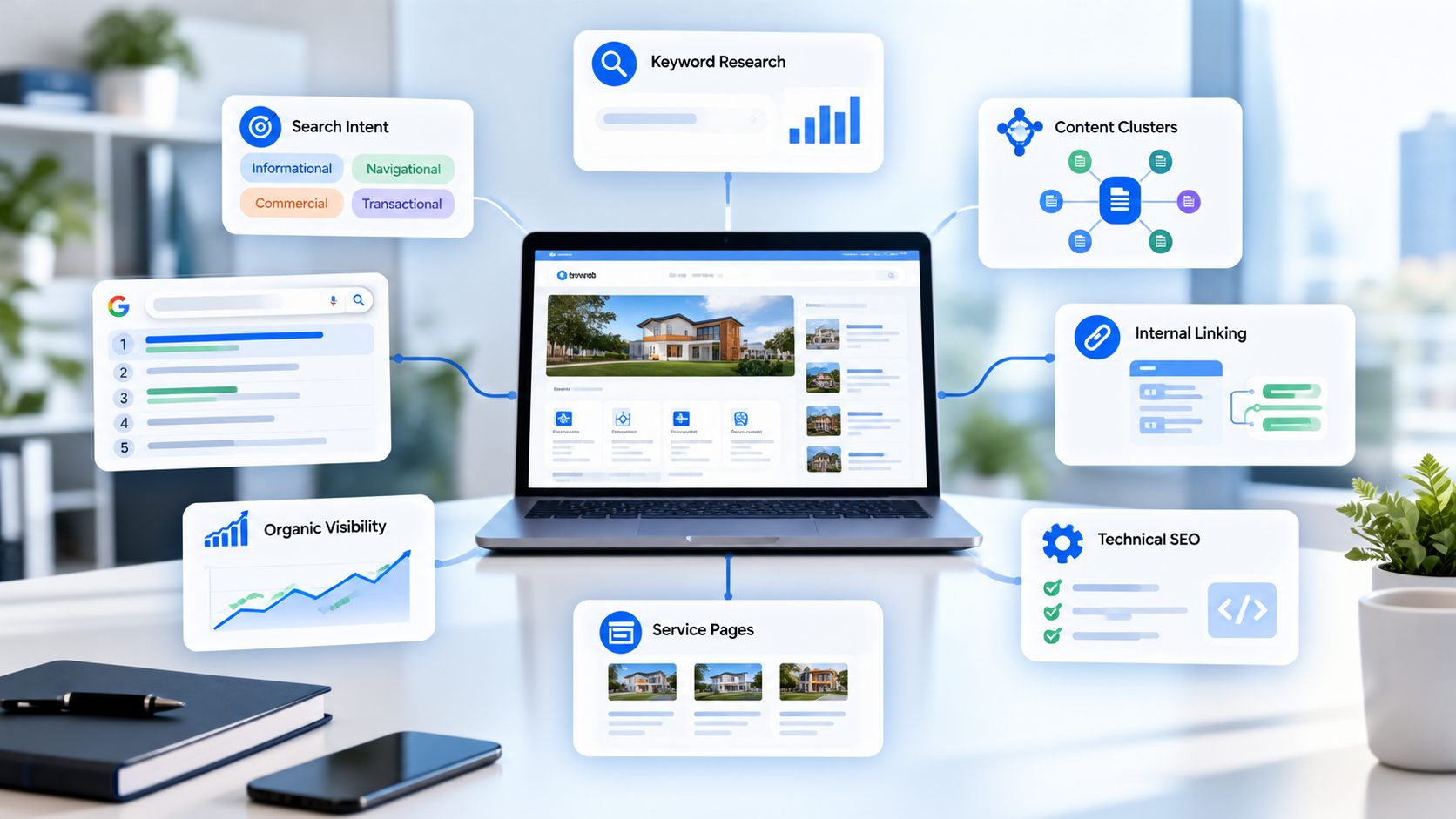
Search engines are becoming increasingly sophisticated at understanding topics, context, relationships, and user intent. Because of this, ranking for a handful of individual keywords is no longer enough to create a strong organic presence.
Your website needs to demonstrate meaningful knowledge around the subjects your customers care about.
This is where topical authority becomes important.
Topical authority refers to the depth, relevance, and organization of content surrounding a particular subject. Instead of publishing disconnected articles, you create a connected collection of pages that answers questions, explains services, addresses customer problems, and supports different stages of the search journey.
An Expert SEO Firm can help develop this authority by combining topic research, search-intent analysis, content planning, internal linking, technical SEO, competitor research, and continuous optimization.
For local service businesses, this approach can be particularly valuable because it helps organize service information, educational resources, location-focused content, and customer questions into a connected website structure.
Topical authority is the depth and breadth of useful information a website provides around a particular subject.
Consider a local HVAC company. A single page targeting “AC repair” provides information about one service, but customers may have many other questions before contacting the business.
They may want to know:
A website that addresses these related subjects can provide a much more complete resource.
The objective isn’t to create hundreds of pages simply to increase website size. Each page should have a clear purpose and contribute to the site’s broader subject coverage.
In simple terms, topical authority is built through relevance, depth, organization, and useful information.
Building topical authority requires a structured process rather than simply publishing content more frequently. An experienced SEO team can combine several strategies to create a connected content ecosystem.
The first step is understanding what your customers search for and why they search for it.
Traditional keyword research often focuses on search volume and competition. Those metrics can be useful, but topical research needs a wider perspective.
An SEO team can identify:
For example, a roofing company may target “roof repair,” but customers could also search for roof leaks, storm damage, roof inspections, maintenance, repair costs, replacement options, and warning signs.
These related searches can become individual content opportunities within a larger topical strategy.
The result is a topic map that covers the broader customer journey instead of focusing on one isolated keyword.
Topic clusters are an important part of topical authority.
A typical cluster contains:
Pillar Content: A broad resource covering the main subject.
Supporting Content: More specific pages addressing related subtopics.
Internal Links: Contextual connections between those pages.
For example, a local plumbing company could build a central topic around plumbing services and support it with resources covering drain cleaning, water heater problems, pipe leaks, emergency plumbing, maintenance, and common plumbing questions.
Each page serves a different purpose while contributing to the same subject area.
This structure can make information easier for visitors to navigate while giving search engines clearer context about the relationships between pages.
A strong topical strategy should consider why someone is searching, not only what they type into Google.
For example, someone searching “what causes a leaking pipe” is probably looking for educational information.
Someone searching “plumber near me” may already be looking for a service provider.
Another person searching “plumbing repair cost” could be comparing options before making a decision.
This is why search intent should influence content planning.
You can strengthen this process by understanding search intent and modern SEO content strategies, including how different user motivations influence the type of information a page should provide.
An SEO strategy that recognizes these differences can create content for awareness, research, evaluation, and decision-making rather than forcing every keyword into the same type of page.
Customers rarely move from their first search directly to a service request.
A potential customer may first discover a problem, research possible solutions, compare alternatives, investigate providers, and finally decide to contact a business.
Your content should support these stages.
Awareness
Explain problems, concepts, symptoms, and basic solutions.
Research
Provide detailed guides, comparisons, examples, and practical information.
Evaluation
Answer questions about services, costs, processes, qualifications, and important considerations.
Decision
Provide clear service information, location relevance, trust signals, and an easy next step.
An Expert SEO Firm can organize content around these stages so informational articles and commercial pages work together.
Creating useful content is only part of the process. Your pages also need to be connected logically.
Internal linking allows users to move naturally from one relevant resource to another. It can also help search engines understand relationships between different sections of your website.
For example, a supporting article about a customer problem can link to a relevant service page. A service page can also link to an educational guide that answers a common customer question.
The anchor text should describe the destination instead of relying on generic phrases.
For example, businesses can review technical SEO strategies for stronger website visibility to understand how crawlability, indexing, website structure, internal links, and technical accessibility can support organic visibility.
This type of contextual connection is more useful than adding unrelated links simply to increase the number of internal links on a page.
Publishing a large volume of shallow articles does not automatically create topical authority.
Every page should have a reason to exist.
Useful content can include:
Content should also avoid unnecessary repetition.
A page should expand the reader’s understanding instead of restating the same idea repeatedly with slightly different wording.
Modern search systems increasingly emphasize usefulness, originality, expertise, and satisfying user needs. A stronger approach to content quality and topic authority development can therefore help businesses move beyond generic, thin, or repetitive publishing.
For local service businesses, informational content should support important commercial pages whenever the connection is genuinely relevant.
Consider a local electrician.
The company could publish an article about signs of an electrical panel problem. Within that article, a relevant section could direct readers toward its electrical panel service.
A roofing company could publish a guide about roof leaks and naturally connect that resource with its roof repair service.
This creates a useful path:
Problem → Information → Solution → Service
The educational content answers the user’s immediate question while making the appropriate service easier to discover.
Your blog and service pages should therefore work together rather than functioning as completely separate parts of the website.
Every business has different services, customers, competitors, locations, and growth objectives.
A standardized content calendar may therefore miss important opportunities.
Custom SEO Services allow the strategy to be developed around the actual characteristics of your business and website.
A customized topical strategy may evaluate:
For example, one business may need additional supporting content around its primary service, while another may first need to consolidate overlapping pages.
The strategy should be based on the website’s actual needs rather than a fixed publishing formula.
Competitor research can reveal subjects your website has not covered adequately.
An SEO team can examine competing websites to identify:
The objective isn’t to copy competing pages.
Instead, competitor analysis can show where your website can provide more complete, clearer, or more useful information.
For example, competitors may describe a service but fail to answer questions about preparation, maintenance, costs, common mistakes, or what customers should expect.
Those unanswered questions can become opportunities for original supporting content.
Topical authority needs a strong technical foundation.
If important pages cannot be crawled, indexed, or easily discovered, valuable content may not reach its full potential.
Technical SEO can address:
Technical SEO is particularly important when a website contains numerous service pages, blog posts, location pages, and supporting resources.
A logical website architecture helps search engines and visitors understand how those pages fit together.
Topical authority is not a one-time project.
Your business changes. Services evolve. Customer questions develop. Competitors publish new resources. Existing information can become outdated.
Regular content reviews can help identify:
This creates a continuous improvement cycle.
Instead of publishing content and forgetting about it, your website becomes an evolving resource that can adapt to changing customer needs and search behavior.
Topical authority requires several SEO disciplines to work together.
An Expert SEO Firm can coordinate:
A practical workflow can look like:
Research → Plan → Create → Connect → Optimize → Measure → Improve
This approach creates a connected website instead of a collection of unrelated articles.
When evaluating an SEO partner, businesses can also review top qualities to look for in an Expert SEO Firm, including customized strategies, technical knowledge, ethical practices, transparent communication, and measurable objectives.
Local service businesses need to establish relevance around both their services and their target audience.
Consider a landscaping company.
Its website may need useful information about lawn maintenance, seasonal services, tree care, irrigation, landscaping projects, common problems, and customer questions.
When these subjects are organized into related clusters, the website can become a more complete information resource.
Topical coverage should also work alongside local SEO, optimized service pages, accurate business information, technical SEO, user experience, and authority-building activities.
The objective is to create a website that clearly communicates what the business offers and provides useful information to potential customers.
Topical authority should not be evaluated using a single ranking position.
An SEO team can monitor multiple indicators, including:
These measurements can reveal where your website is gaining visibility and where additional work may be useful.
For example, if several related pages begin generating impressions around the same subject, you may have an opportunity to develop additional supporting resources.
Performance data can therefore help guide the next stage of your topical strategy.
Your website may already contain useful service pages, blog posts, and resources. The challenge is making those assets work together as one coherent SEO strategy.
A structured topical approach can help identify content gaps, organize related subjects, strengthen internal linking, support service pages, and create a more useful experience for your audience.
If your current content strategy feels disconnected or you aren’t sure which topics should be developed next, a customized SEO strategy can provide a clearer roadmap.
Topical authority refers to the depth and relevance of a website’s content around a specific subject. It is developed through comprehensive, useful, connected resources that address multiple aspects of a topic and satisfy relevant search intent.
An Expert SEO Firm can use topic research, search-intent analysis, content clusters, internal linking, technical SEO, competitor analysis, service-page optimization, and ongoing content improvements to develop broader subject coverage.
No. Content quantity alone does not establish topical authority. Pages should provide meaningful information, satisfy search intent, address relevant subjects, and contribute to the website’s overall topical structure.
Internal linking connects related pages and helps visitors discover additional information. It can also help search engines understand relationships between different pages, subjects, and sections of a website.
Custom SEO Services can tailor keyword research, topic planning, content development, technical optimization, and internal linking around your industry, audience, competitors, website structure, and business goals.
Yes. Local businesses can develop topical coverage around services, customer problems, frequently asked questions, industry subjects, and geographic markets. This can create a more comprehensive online resource for potential customers.
There is no universal timeframe. Progress depends on factors such as website history, competition, existing content, technical condition, content quality, topic coverage, internal linking, and consistency.
Topical authority is about creating a website that demonstrates meaningful depth around the subjects your customers care about.
Rather than producing disconnected blog posts, businesses can create topic clusters, map content to search intent, connect supporting resources with service pages, strengthen internal linking, improve technical foundations, and continuously update their content ecosystem.
With Custom SEO Services, your strategy can be developed around the specific needs of your business instead of relying on a generic publishing formula.
An Expert SEO Firm can bring research, content strategy, technical SEO, internal linking, competitor analysis, and performance measurement together into one connected approach.
The objective isn’t simply to publish more content. It is to build a website that provides useful, relevant, organized information across the subjects that matter most to your customers.