

Why Do Businesses Need Custom SEO Services for AI Search?
Sep 30, 2026


In today’s search landscape, having great content is no longer enough to guarantee online visibility. Your website also needs a strong technical foundation that allows search engines to crawl, understand, index, and serve your pages efficiently.
As search continues to evolve toward AI-powered experiences, technical SEO has become even more important. Search engines and AI-driven search experiences rely on clear website structures, accessible content, strong performance, and understandable signals to determine which information deserves visibility.
Whether you are building a new website or improving an established one, working with an Expert SEO Firm can help you identify technical barriers that may be limiting your organic performance.
Technical SEO focuses on optimizing the technical infrastructure of your website so that search engines can efficiently discover, crawl, interpret, and index your content.
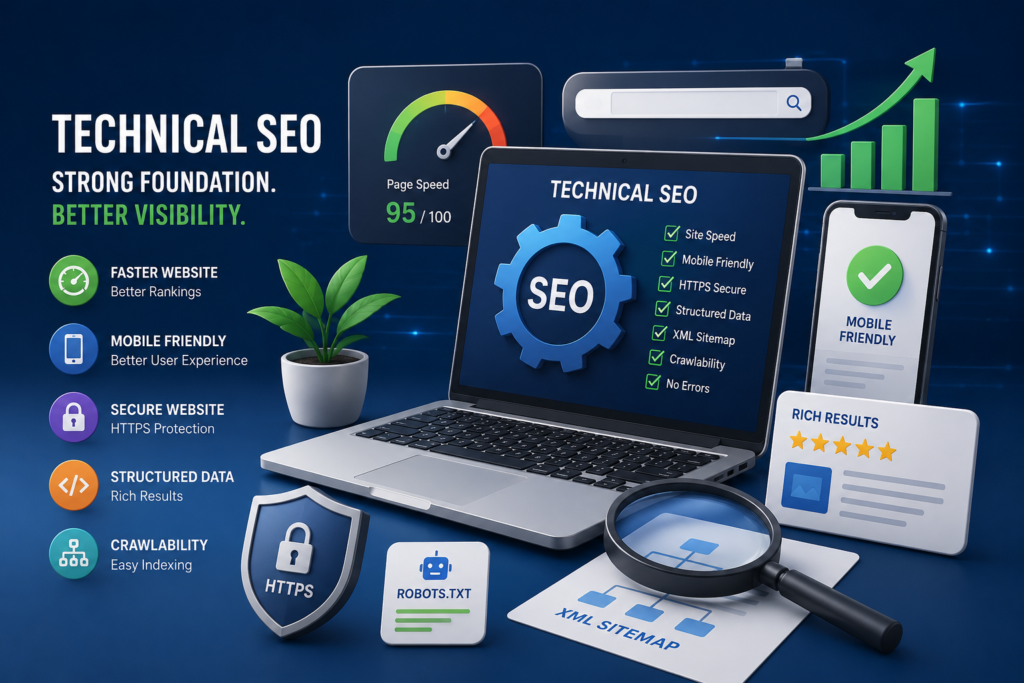
Unlike content-focused SEO, technical SEO works largely behind the scenes. It covers areas such as:
A technically sound website gives search engines fewer obstacles to overcome when accessing your important content.
Think about publishing an excellent article that answers exactly what your audience is searching for. If search engines struggle to crawl the page, understand its structure, or determine which URL should be indexed, the quality of the content alone may not deliver its full SEO potential.
Technical SEO helps create the foundation on which content, authority, and other optimization efforts can perform effectively.
It can also improve the user experience. Faster pages, easier navigation, mobile-friendly layouts, and secure connections make it easier for visitors to interact with your website.
The result is a stronger combination of search accessibility and user experience.
Page performance directly affects how users experience your website. Slow-loading pages can increase frustration and make visitors leave before interacting with your content.
Start by reviewing:
Core Web Vitals can also provide useful insights into loading performance, responsiveness, and visual stability.
The objective isn’t simply to make a website faster. It is to create a smooth experience where important content becomes available quickly and pages remain stable while loading.
Search engines increasingly evaluate websites with mobile users in mind. Your website should therefore provide a consistent experience across smartphones, tablets, and desktops.
Check whether:
A responsive website helps ensure that your content remains accessible regardless of the device used to access it.
Search engines need to discover your pages before they can consider them for search visibility.
Technical SEO helps you control how search engine crawlers move through your website.
Important areas include:
You should also regularly identify pages that are unintentionally blocked from crawling or indexing.
A technically clean website makes it easier for search engines to understand which pages matter most.
Your website structure should make sense to both users and search engines.
Organize related content into clear categories and connect important pages through contextual internal links.
For example, a service page can link to relevant supporting articles, case studies, FAQs, and related services. This creates topical relationships between pages while helping users discover additional information.
A logical architecture can also help search engines understand your website’s broader subject areas.
Structured data provides additional context about your content.
Depending on the page type, relevant structured data can help search engines understand information such as:
Structured data should accurately represent the visible content on the page. It should never be used to mislead search engines or add information that users cannot find on the page.
Technical issues can quietly weaken website performance.
Broken links may create poor user experiences, while incorrect redirects can prevent users and crawlers from reaching the intended destination.
Regularly audit your website for:
Fixing these issues helps maintain a cleaner and more efficient website structure.
Search engines may encounter multiple URLs containing similar or identical content.
For example, tracking parameters, duplicate category pages, or different URL variations can create unnecessary duplication.
Canonical tags can help communicate which version of a page should be treated as the preferred URL when appropriate.
However, canonicalization should be implemented carefully. It is not a substitute for fixing broader site architecture or duplication problems.
Search is becoming increasingly focused on understanding entities, relationships, context, and user intent.
That makes technical clarity especially valuable.
If your website has a logical structure, accessible content, descriptive headings, clear internal links, consistent information, and properly implemented structured data, search systems have stronger signals for understanding your pages.
For businesses targeting visibility across Google Search, Google AI Overviews, ChatGPT, and Gemini, technical SEO should therefore work alongside high-quality content and authoritative information.
The goal isn’t to optimize separately for every search experience. Instead, build a website that is technically accessible, useful, trustworthy, and easy for modern search systems to interpret.
Every website has different technical challenges. A local business website may struggle with indexing and location pages, while an ecommerce website may face duplicate URLs, faceted navigation, or large-scale crawl issues.
This is where Custom SEO Services can provide a more strategic approach.
Instead of applying the same checklist to every website, a customized strategy can prioritize issues according to your website architecture, business objectives, competition, content structure, and search opportunities.
An Expert SEO Firm can audit your technical foundation, identify high-impact problems, and create a prioritized roadmap for improvements.
The objective is not to fix every technical issue simply because an SEO tool reports it. The objective is to identify problems that can genuinely affect crawling, indexing, user experience, and organic visibility.
Technical SEO works best when it is connected to the rest of your SEO strategy.
Your website may have:
Sustainable organic visibility requires these elements to work together.
Technical SEO creates the foundation. Content addresses search intent. Internal linking establishes relationships between pages. Authority signals strengthen credibility. Together, these components create a stronger search presence.
Before considering your technical SEO strategy complete, review these areas:
Technical SEO involves optimizing a website’s infrastructure so search engines can efficiently crawl, understand, and index its pages. It includes website speed, mobile usability, crawlability, indexing, structured data, redirects, canonicalization, and other technical factors.
Technical SEO removes barriers that can prevent search engines from accessing or understanding your website. Better crawlability, indexing, performance, mobile usability, and site architecture can help your important pages become more accessible to search engines and users.
Yes. AI-driven search experiences need reliable signals to understand website content and context. Clear site architecture, accessible content, structured data, descriptive page elements, and strong technical foundations can support better content interpretation and discoverability.
Yes. Custom SEO Services can incorporate technical SEO based on your website’s specific problems and objectives. This may include technical audits, crawlability improvements, indexing analysis, Core Web Vitals optimization, structured data, redirects, and website architecture improvements.
A technical SEO audit should be performed regularly, particularly after major website changes, migrations, redesigns, or platform updates. Ongoing monitoring can also help identify new crawl, indexing, performance, and structural issues before they become significant problems.
Ready to Improve Your Website Visibility?
Strengthen your website with a technically sound SEO strategy designed around your business goals. Partner with an Expert SEO Firm for tailored Custom SEO Services that improve crawlability, website performance, search visibility, and long-term organic growth.
Ready to take the next step? Contact Us today and discuss your SEO goals with our experts.