

Can an Expert SEO Firm Help SaaS Brands Beat Bigger Rivals?
Oct 27, 2026


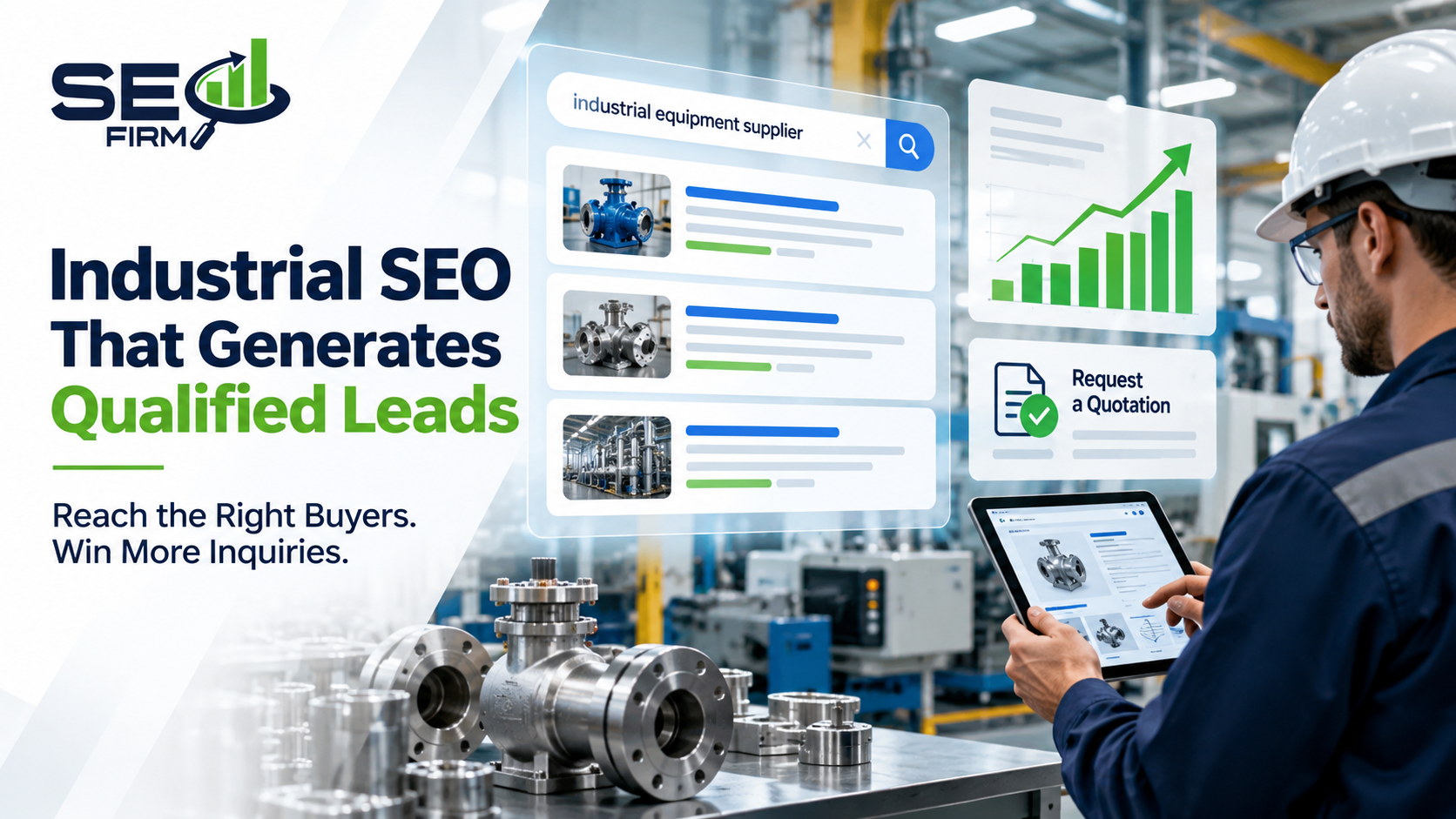
Yes, custom SEO services can help your industrial business turn relevant search traffic into qualified leads by connecting your products and expertise with the questions buyers ask during supplier research. The key is to target commercially relevant searches, build detailed product and application pages, improve technical website performance, and provide clear paths for prospects to request quotations or consultations.
Industrial buyers often have specific requirements involving specifications, tolerances, materials, production capacity, certifications, compatibility, and delivery expectations. Generic marketing content may attract visitors without giving them enough information to evaluate your business.
A more effective strategy focuses on the questions buyers ask before contacting a supplier. When your website provides useful answers and makes the next step straightforward, organic search can become a valuable part of your B2B lead-generation process.
Industrial purchasing decisions frequently involve multiple stakeholders. An engineer may investigate technical compatibility, a procurement manager may compare suppliers, and a business leader may assess cost, reliability, and long-term value.
Your SEO strategy should reflect these different needs.
A page designed for a technical evaluator should provide precise specifications and application details. A page intended for procurement teams may need information about minimum order quantities, lead times, quality processes, and quotation requirements.
Industrial SEO also faces challenges that are less common on smaller consumer websites. Product catalogs may contain thousands of pages, technical documentation may be difficult to navigate, and some valuable search terms may have modest volume but strong commercial relevance.
This is why a tailored strategy can be more effective than applying a generic checklist to every industrial website.
Your potential customers may search for product names, material grades, technical properties, equipment types, replacement parts, or solutions to operational problems.
For example, a manufacturer of industrial filtration equipment might target general phrases such as “industrial filters.” However, its buyers may also search for filters suitable for specific operating temperatures, contaminants, flow rates, or equipment configurations.
Build your keyword research around several categories:
Talk to your sales and engineering teams to understand how customers describe their requirements. Review quotation requests, support tickets, product documentation, and common objections to uncover language that may not appear in standard keyword tools.
Then evaluate each opportunity by relevance, competition, search intent, and potential business value.
The goal is not to attract every visitor interested in industrial products. It is to attract the people whose needs match what your business can actually supply.
Your website should help buyers move from a broad requirement to a specific product or solution.
If you manufacture industrial valves, for example, a useful website structure might include a main valve category, individual product pages, material-specific information, application pages, and technical resources.
Each page should have a distinct purpose.
A product page may include:
Application pages should explain how your products address the requirements of a particular environment or process. Avoid duplicating the same paragraphs across numerous industry pages with only minor keyword changes.
Where technical claims matter, ensure the information is reviewed by qualified staff. Accurate product data helps prospects assess suitability and reduces unnecessary back-and-forth during the sales process.
Industrial buyers often research a problem before they know which supplier or product they need.
Your content can help them understand the issue, compare possible approaches, and identify the information required to select a suitable solution.
Consider publishing resources about:
For example, a manufacturer of industrial pumps could publish a guide explaining how flow rate, pressure requirements, fluid properties, and operating conditions affect pump selection.
Such a guide should offer practical information rather than simply repeating product benefits. It can then direct interested readers to relevant product categories or technical consultation options.
This creates a natural relationship between informational content and commercial pages.
Technical SEO becomes increasingly important as product catalogs and documentation libraries grow.
If your website contains duplicate product variations, broken specification sheets, outdated URLs, or important pages buried deep in the navigation, search engines and users may struggle to discover relevant information.
Start with a structured technical audit.
Review crawlability, indexability, canonical URLs, redirects, XML sitemaps, mobile usability, internal links, and page performance. Confirm that important product pages are accessible and that obsolete pages are handled appropriately.
Pay special attention to product filters and URL parameters. Filtering by material, size, or configuration can create many similar URLs. Make sure your implementation allows useful pages to be discovered without encouraging unnecessary duplication.
SEOS Firm’s resource on technical SEO for better website visibility can help you understand the technical foundations that support organic performance.
A buyer should not need to search through several unrelated pages to find essential product information.
Organize documentation by product family, model, application, or relevant technical category. Use descriptive titles and provide clear links between product pages and their supporting resources.
If you offer technical PDFs, ensure that important information is also available in accessible webpage content where practical. Search engines and visitors should be able to understand the purpose of a resource without relying entirely on a file download.
Include useful details such as units of measurement, model numbers, supported configurations, and revision dates where relevant.
Do not publish confidential customer specifications or sensitive engineering information merely to increase content volume. Your objective is to provide the information prospective buyers need and are authorized to access.
Traffic alone does not generate revenue. Your website must help the right visitors take the next step.
For industrial businesses, useful conversion actions may include requesting a quote, arranging a technical consultation, downloading a specification sheet, or asking about product availability.
Make these actions visible on relevant pages.
A quotation form should collect enough information to help your team respond effectively without overwhelming the visitor. Depending on your business, useful fields may include product category, application, quantity, location, and preferred contact method.
Provide context about what happens after submission. For example, explain whether the inquiry will be reviewed by a sales engineer or routed to a product specialist.
You should also ensure that forms work correctly on mobile devices, confirmation messages appear reliably, and submissions reach the appropriate team.
Measure form completions and lead quality, not just button clicks.
Industrial buyers may be making high-value purchasing decisions where reliability and technical competence matter more than promotional language.
Support your claims with credible information.
Depending on what your business can verify, this may include technical documentation, quality certifications, manufacturing capabilities, documented case studies, equipment details, and clearly explained quality-control processes.
Avoid vague statements such as “best manufacturer” unless you can substantiate the underlying claim. Specific, accurate descriptions help buyers understand what distinguishes your company.
Your content should also identify its intended application and limitations. A product that works well in one operating environment may be unsuitable in another.
If your company has genuine engineering expertise, use it to explain selection criteria, common mistakes, and practical considerations. That expertise can make your website more useful to both searchers and prospective customers.
Backlinks and industry references can support discoverability and reputation when they come from relevant, credible sources.
You can pursue legitimate opportunities through technical publications, supplier partnerships, industry associations, educational collaborations, and original research.
A well-researched technical guide may be more valuable for outreach than a generic blog post because it gives other professionals a reason to reference your work.
Focus on relevance and editorial value rather than buying large quantities of links.
Your internal linking strategy matters too. Connect educational guides to relevant product pages and connect product pages to supporting specifications. This helps visitors explore the site while clarifying relationships between related resources.
Industrial sales cycles can be lengthy, and a visitor may return several times before requesting a quotation.
Track metrics that connect SEO activity to commercial outcomes.
| Metric | Business value |
| Organic impressions | Shows search visibility |
| Non-branded clicks | Measures discovery beyond existing brand demand |
| Product-page visits | Reveals interest in specific offerings |
| Specification downloads | Indicates technical research activity |
| Qualified inquiries | Measures relevant sales opportunities |
| Quote-to-order rate | Connects lead generation with sales outcomes |
Where your systems allow, connect analytics with CRM data to understand which landing pages contribute to qualified opportunities.
Use these insights to improve pages that attract relevant visitors but fail to generate inquiries. Conversely, expand topics that consistently bring in qualified prospects.
Start by identifying your most commercially important products and target industries. Audit their existing pages, research relevant search terms, and review how competitors present their products.
Next, prioritize technical fixes and improve the landing pages most likely to influence sales. Develop supporting content around buyer questions and connect it to the relevant commercial pages.
Finally, measure leads and review the results with your sales team. Their feedback can help you distinguish useful inquiries from irrelevant traffic and refine your keyword priorities.
For a broader overview of the company’s approach, explore SEOS Firm’s services and business information.
Custom SEO services can help industrial businesses turn search demand into qualified leads by making technical information discoverable, targeting commercially relevant searches, and creating clear paths from research to inquiry.
Start with the products and applications that matter most to your business. Build accurate landing pages, fix technical barriers, support buyers with useful resources, and measure the quality of leads generated.
A focused industrial SEO strategy can help your business attract prospects who are more relevant to your capabilities and sales goals.
Explore Tailored SEO Strategies
Yes. SEO can attract buyers searching for specific products, technical specifications, applications, and suppliers. Results depend on the relevance of your pages, competition, technical quality, and how effectively your website converts inquiries.
Prioritize product, application, specification, industry, and supplier-related searches that match your capabilities. Consult sales and engineering teams to identify terminology customers actually use.
Technical SEO improves discoverability and accessibility by addressing indexing, duplicate URLs, broken links, site structure, and performance. These improvements help search engines and users reach important product information.
Yes, when the content answers genuine buyer questions. Technical guides can explain selection criteria, maintenance, compatibility, and application considerations while supporting relevant product pages.
Track qualified inquiries, quotation requests, specification downloads, relevant organic visits, and conversions. Where possible, connect these metrics with CRM data to assess the quality and commercial value of leads.