
Can an Expert SEO Firm Help SaaS Brands Beat Bigger Rivals?
Oct 27, 2026


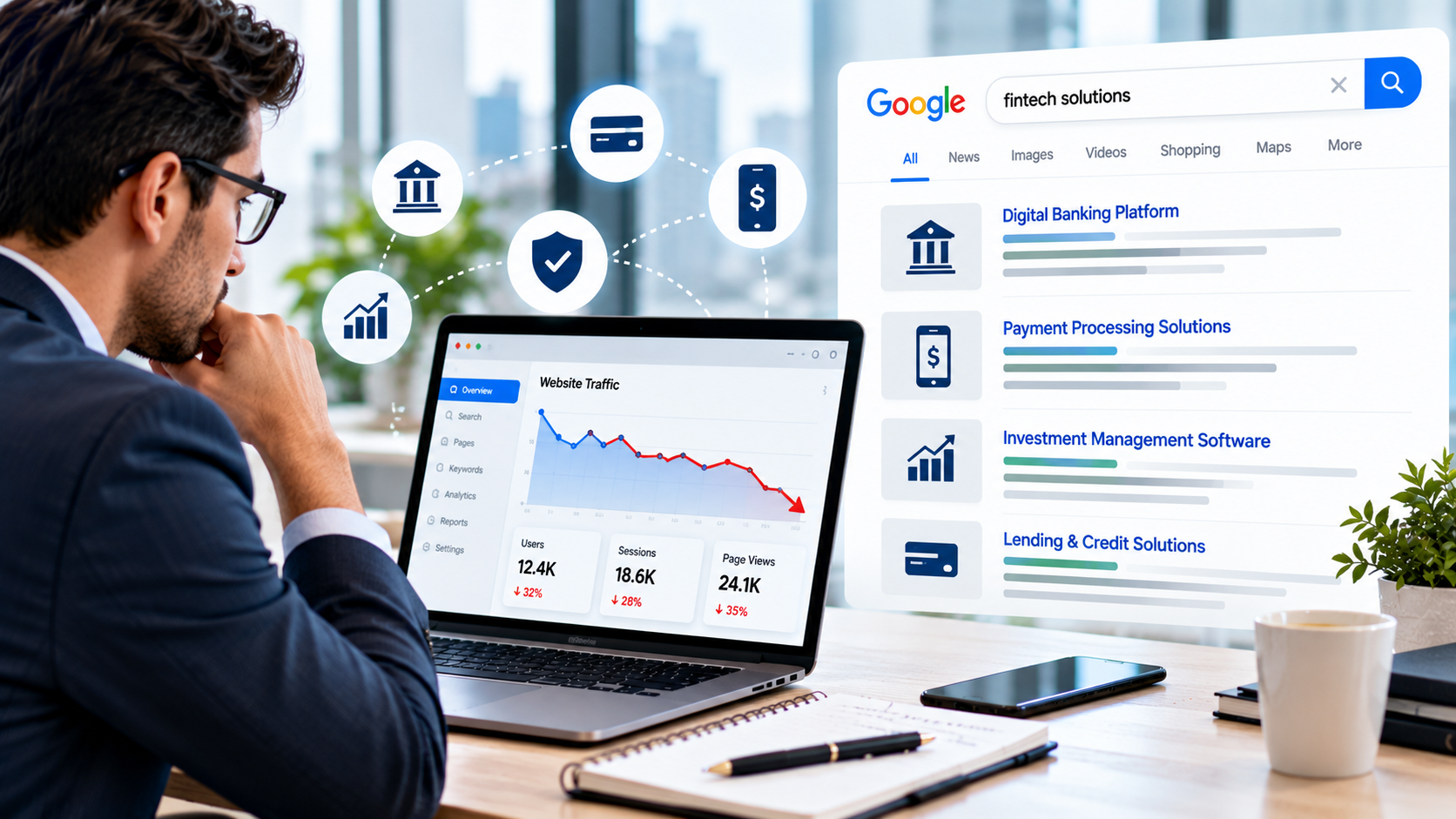
Your fintech website can publish detailed financial guides, insightful industry analysis, and well-researched articles yet still lose organic traffic. This happens because content quality is only one part of SEO. Search visibility also depends on technical accessibility, search intent, competition, website credibility, internal linking, and whether your pages continue to meet users’ needs.
Financial technology is a competitive industry. Users researching payment platforms, digital banking, lending software, investment tools, and financial management products often expect clear information and credible explanations before taking action.
If your traffic is declining despite consistent publishing, producing even more articles may not be the right solution. You should first identify what changed, which pages were affected, and whether the problem originates from technical SEO, content relevance, or competitive positioning.
One of the most common causes of declining organic performance is a mismatch between the content you publish and what searchers expect to find.
Consider someone searching for payment processing software for an online business. They may want to compare transaction fees, integration options, settlement times, security features, and supported payment methods.
A general article explaining how digital payments work may provide useful information, but it does not fully answer a software buyer’s questions.
The same issue occurs when a fintech company targets informational keywords but expects visitors to request demos immediately.
To improve relevance, categorize your priority queries by intent:
Review the pages ranking for your important keywords. Identify their format, depth, angle, and intended audience. Then improve your content so it addresses the same underlying need while offering additional value.
Even excellent content cannot attract organic traffic if search engines cannot properly access or index it.
Fintech websites sometimes contain complex product pages, documentation libraries, location-specific pages, filtered directories, or JavaScript-based interfaces. These elements can create technical issues when implemented incorrectly.
Start by examining Google Search Console for indexing changes and page-level errors. Compare affected URLs with pages that continue to perform well.
Investigate:
An XML sitemap should accurately identify the canonical pages you want search engines to discover. It should not replace a proper internal linking structure.
If traffic declines suddenly, prioritize technical investigation before rewriting every article. You may discover that a relatively small configuration change is preventing valuable pages from appearing in search results.
For practical guidance, read SEOS Firm’s resource on technical SEO improvements for website visibility.
Publishing detailed content does not automatically make your page the most useful result.
Your competitors may have introduced better comparisons, more recent information, clearer explanations, or stronger resources for specific customer segments. They may also have built stronger reputations within the fintech sector.
Conduct a page-level competitor analysis rather than simply comparing domain-wide traffic estimates.
For each declining page, ask:
Suppose your article explains payment security but does not discuss implementation responsibilities, common integration risks, or evaluation criteria. A competitor that addresses those questions may offer a more complete resource for its audience.
Do not copy competitor pages. Identify the missing information and improve your own resource with accurate, original, and relevant material.
Financial topics can affect important decisions involving money, business operations, privacy, and security. Readers therefore need clear reasons to trust the information they encounter.
Your website should communicate who produces its content, what expertise supports it, and when the information was reviewed.
Useful practices include:
Avoid adding unsupported claims about security, regulatory compliance, investment performance, or guaranteed savings. These statements can undermine trust and create legal or reputational risks.
Credibility is not a shortcut to rankings, and no individual trust signal guarantees better positions. However, accurate, transparent content gives readers a stronger basis for evaluating your business.
Fintech brands frequently compete for generic terms such as “digital banking,” “payments,” or “financial technology.” These phrases can attract a wide audience, but they may not align with the company’s product or resources.
A more focused strategy can uncover searches with clearer commercial relevance.
For example, a payment technology provider might target topics such as recurring payment integration, international settlement workflows, payment reconciliation software, or payment processing for a specific business model.
Evaluate these opportunities using search demand, ranking difficulty, product relevance, and conversion potential.
You should also consider the actual language customers use. Sales calls, customer support questions, product documentation, and feedback from implementation teams can reveal valuable search topics that standard keyword research may overlook.
An expert SEO firm can help assess keyword opportunities, content gaps, and competitive positioning when building a more focused organic growth strategy.
Some pages lose visibility because the information becomes outdated or the search landscape changes.
A guide that once answered a common question may no longer cover current product capabilities, industry terminology, or relevant evaluation criteria. Other pages may overlap with newer content on your own website.
Use Google Search Console and analytics data to identify pages with declining clicks, impressions, conversions, or engagement. Compare recent performance with earlier periods while accounting for seasonality and changes in search demand.
Next, determine whether each page should be updated, consolidated, redirected, or left unchanged.
Updating a page should mean improving its usefulness, not merely changing its publication date. Add missing explanations, correct inaccurate information, strengthen examples, and remove obsolete sections.
Where multiple pages target the same intent, consider consolidating them into a stronger resource if that better serves readers and preserves relevant signals.
A fintech website might publish excellent resources that remain difficult for users and crawlers to discover because they are disconnected from the site’s main navigation and related content.
Internal links should create logical relationships between educational resources, product pages, comparison pages, and relevant service information.
For example, an article about payment reconciliation could link to a detailed integration guide or a relevant product page. The link should help the reader move naturally from understanding the problem to evaluating a solution.
Use descriptive anchor text that communicates the destination’s subject. Avoid repeating the same exact-match phrase mechanically or adding links where they do not help the reader.
Review important pages for orphaned content, excessive click depth, and links that point to outdated destinations.
Search experiences increasingly provide direct answers, summaries, and synthesized information. This can change the relationship between visibility, clicks, and organic traffic.
Your content should make important information easy to understand. Answer the main question clearly, use descriptive headings, explain relevant concepts, and provide supporting evidence or examples.
For fintech brands, this is particularly important when explaining complicated concepts such as payment settlement, fraud prevention, embedded finance, or digital identity verification.
Do not write exaggerated claims simply to attract AI-generated citations. Instead, provide accurate explanations that stand independently and help readers make informed decisions.
SEOS Firm’s guide to optimizing for Google AI Overviews offers additional context about structuring useful content for evolving search experiences.
A practical recovery process should identify the cause before committing resources to changes.
First, segment the decline. Determine whether the issue affects the entire domain, one directory, a specific group of pages, or a particular search intent.
Second, investigate technical health. Review indexing, crawlability, canonicalization, redirects, and server behavior.
Third, compare search performance. Identify which queries lost impressions or clicks and whether search intent or competing pages changed.
Fourth, prioritize improvements. Fix critical technical problems, improve pages with meaningful existing demand, and create new content only where a genuine gap exists.
Finally, monitor results. Track impressions, clicks, qualified leads, and conversions. Allow sufficient time to evaluate changes instead of making repeated edits without evidence.
Fintech websites can lose traffic despite strong content because search performance depends on more than writing quality. Technical issues, changing intent, outdated information, competitive improvements, weak internal links, and insufficient credibility can all contribute.
Start with the pages that matter most to your business. Diagnose their performance, correct technical barriers, strengthen their usefulness, and connect them to relevant product information.
A focused, evidence-based recovery plan gives you a clearer path toward sustainable organic visibility.
Explore SEOS Firm’s SEO Solutions
Possible causes include indexing issues, changing search intent, stronger competitors, outdated content, keyword cannibalization, or declining search demand. Use Search Console and analytics to identify affected pages before making changes.
No. Helpful content is important, but rankings also depend on technical accessibility, relevance, competition, and other search systems. Strong content cannot compensate for every technical or strategic weakness.
Review important pages periodically and whenever meaningful changes affect the information. Update inaccurate details, outdated examples, product descriptions, or regulatory references when necessary.
Technical SEO helps search engines discover and index valuable pages. It also supports usability by addressing problems such as broken links, slow pages, duplicate URLs, and inaccessible content.
Monitor organic clicks, impressions, query performance, qualified leads, sign-ups, and conversions. Compare equivalent time periods and investigate seasonality before attributing changes to individual SEO updates.