
Why Do Cybersecurity Brands Struggle to Rank on Google?
Oct 25, 2026


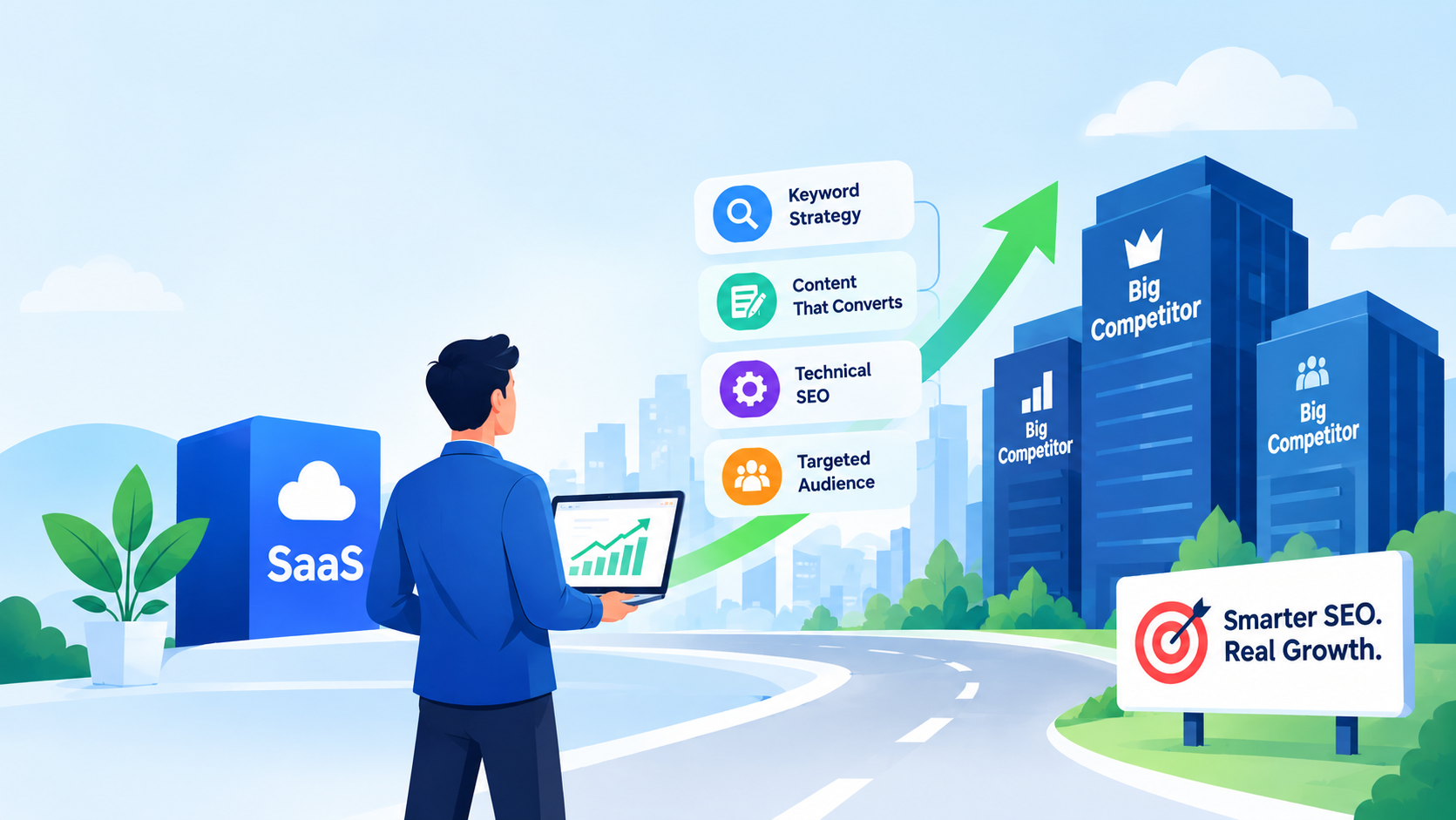
When you compete in the software-as-a-service (SaaS) market, you may face companies with larger marketing budgets, established domain authority, extensive content libraries, and stronger brand recognition. Competing against them can feel difficult, especially when your product solves a specific problem but your website struggles to attract qualified visitors.
However, a bigger competitor does not automatically have the better answer for every customer.
Your SaaS business can find opportunities by targeting a narrower audience, addressing specific use cases, improving product-related content, and making your website easier for search engines and potential customers to understand. Instead of trying to outrank established brands for every broad keyword, you can build visibility around searches that match your product’s real strengths.
An Expert SEO Firm can help you identify those opportunities and turn them into a practical growth strategy. The goal is not simply to increase traffic. It is to attract people who are likely to evaluate, trial, or purchase your software.
A common mistake is targeting the same broad keywords as industry leaders. If you sell project management software, for example, competing immediately for a term such as “project management software” may require significant resources.
Broad keywords often have mixed intent. Searchers may want definitions, comparisons, free tools, product reviews, or enterprise solutions. A high ranking does not necessarily mean that visitors are ready to become customers.
Instead, identify more specific searches that reveal a clear business need.
Consider these examples:
These queries may have lower search volumes, but they can attract a more relevant audience.
Review your product features, customer questions, sales conversations, and support tickets to identify language customers use when describing their problems. Then map those needs to keywords and pages that answer them directly.
You do not need to copy every page published by a larger SaaS competitor. You need to identify areas where its content fails to meet a particular audience’s needs.
Start by comparing competing websites across several dimensions:
Suppose a large software provider has a general automation guide but offers little information for dental practices, logistics companies, or independent consultants. If your product serves one of these audiences, you may be able to create more focused and useful content.
An SEO competitor analysis should therefore go beyond checking rankings. It should help you discover where your expertise, product capabilities, or customer understanding can create a better result for searchers.
For SaaS companies, product-led content can connect educational searches with product discovery.
A useful content plan may include four layers:
Problem-focused content: Explain the challenges your audience experiences before choosing a tool.
Solution-focused content: Show methods and workflows that can address those challenges.
Use-case pages: Explain how your software supports specific industries, roles, or tasks.
Evaluation pages: Help buyers compare features, integrations, implementation requirements, and alternatives.
For example, a customer relationship management platform could publish an educational guide to managing sales follow-ups, a workflow article about automating reminders, and a use-case page explaining how its software supports small B2B sales teams.
Each page should serve a distinct purpose. Avoid creating dozens of near-identical pages that simply replace one industry keyword with another. If the content provides no meaningful difference, it is unlikely to offer much value to readers.
SaaS buyers often compare products before booking a demo or starting a free trial. Comparison content can therefore attract commercially valuable traffic.
However, a page that merely claims your product is the best may fail to answer the buyer’s real questions.
A stronger comparison page explains:
If you publish an “alternative to” page, ensure that it contains original analysis rather than a generic list of competitor features.
Use current, verifiable product information. If pricing or features change frequently, include a review date and establish a process for keeping the page updated. Honest comparison content can build trust while helping qualified buyers understand whether your product fits their needs.
Publishing more articles will not solve every visibility problem. Your website also needs a sound technical foundation.
SaaS websites can become complex as they grow. They may contain documentation, help centres, app directories, feature pages, blog posts, integration pages, and gated resources. Without a clear structure, important pages can become difficult to discover or index.
Review the following areas:
You can explore technical SEO strategies for better website visibility to understand how crawlability, indexing, site structure, and performance support organic growth.
Traffic alone is not a reliable measure of SaaS SEO success. A page can attract thousands of visitors without generating trials, demo requests, or meaningful sales conversations.
Set up conversion tracking around the actions that matter to your business. Depending on your sales model, these might include:
Use landing-page reports to determine which topics attract visitors who take the next step. A smaller page that generates relevant demos may be more valuable than a broad article that produces large volumes of unqualified traffic.
Also consider the customer journey. A person searching for an educational guide may not be ready to buy immediately. Provide useful next steps, such as related tutorials, product walkthroughs, comparison resources, or relevant feature pages.
SaaS buyers increasingly ask detailed questions in search engines and AI-powered tools. They may want to understand how a product works, compare solutions, or determine whether a particular workflow can be automated.
Prepare your website by answering those questions clearly. Use descriptive headings, concise definitions, useful examples, and accurate product information. Explain technical concepts in language your intended audience can understand.
Organize related content so that educational resources connect logically to use-case and product pages. Keep company information and product descriptions consistent across your website.
You can review how an Expert SEO Firm can optimize for Google AI Overviews for additional context on content clarity, technical accessibility, and modern search visibility.
Remember that no SEO provider can guarantee that a page will appear in an AI-generated answer. Focus on making your content useful, discoverable, and trustworthy rather than chasing a single search feature.
A focused roadmap helps you prioritize work instead of publishing content without a clear purpose.
Days 1–30: Research and diagnosis
Audit technical issues, identify priority product pages, review competitor gaps, analyse search intent, and establish conversion tracking.
Days 31–60: Improve core pages
Refresh key product pages, strengthen internal linking, publish a high-value use-case page, and resolve technical issues that affect important URLs.
Days 61–90: Expand and measure
Publish supporting content, improve comparison resources, review organic conversions, and identify pages that need further optimization.
Use performance data to adjust priorities. Search results can change, and some topics may take longer than others to produce meaningful results. A roadmap should provide direction while allowing your team to respond to new opportunities.
Your SaaS business does not need to imitate the largest brands to build organic visibility. It needs to understand its audience, choose realistic search opportunities, publish useful product-related content, and remove technical barriers that limit discoverability.
A focused SEO strategy can help you compete where your product offers a meaningful advantage. The right approach combines keyword research, product-led content, technical improvements, internal linking, and conversion measurement.
Yes, for selected searches. A smaller company may compete by targeting specific use cases, creating more relevant content, improving technical SEO, and addressing customer questions that larger competitors overlook. Results depend on competition, website quality, and the usefulness of the content.
Start with keywords that closely match your product, audience, and customer problems. Specific use-case, integration, workflow, and comparison searches may be more commercially relevant than broad industry terms.
Yes. Product-led content connects customer problems with relevant features and workflows. It can help visitors understand how a product works while supporting discovery, evaluation, and conversion.
Measure organic impressions, clicks, landing-page engagement, free-trial registrations, demo requests, qualified leads, and assisted conversions. Use metrics that reflect your sales model instead of judging success by traffic alone.
Timelines vary according to competition, website condition, content quality, and resources. Some technical improvements may have an earlier impact, while building authority and earning competitive rankings generally requires sustained effort.